Life is a Highway

Life is a Highway
Source: GeoCaching.com
Showing posts with label Richard Nixon. Show all posts

Saturday, September 19, 2015

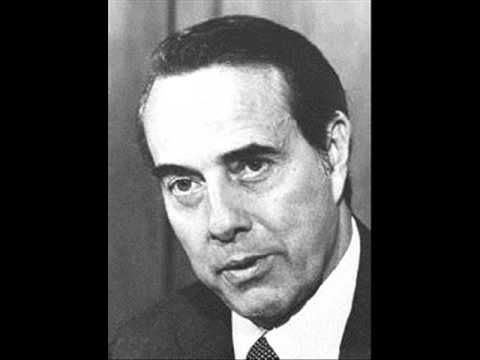
Daniel JB Mitchell: WOR News Radio- Senator Robert J. Dole: 'Castigates Anti-War Democrats on Vietnam: 3-27-1971'

Source:Daniel JB Mitchell- U.S. Senator Robert J. Dole (Republican, Kansas) Chairman of the Republican National Committee (1971-72)

Source:The New Democrat 

"Republican Senator and Republican National Chairman Robert Dole castigated anti-war Democrats regarding the Vietnam War in this excerpt from a radio newscast. WOR, New York City, March 27, 1971. Dole was later the Republican candidate for President in 1996."  


President Richard Nixon was very paranoid about the anti-war movement of the late 1960s and early 1970s. He thought these New-Left protesters were not just being influenced by the Communist Party, but that Communists were running this movement. Even though his own White House couldn’t find any evidence linking the Communist Party directly with the anti-war movement. President Nixon's own staff like Bud Krogh admitted as such. 

Senator Robert Dole who of course is better known as Bob Dole, was Chairman of the Republican National Committee in 1971-72. What he was doing here assuming the WOR radio report is correct was expressing the views of the President of the United States about the anti-war movement in the country.

Bob Dole, was one of the most partisan people in Congress back then and almost had to be as Chairman of the RNC. And was also one of the most skillful politicians that has ever served in Congress. You almost have to be to lead your party in the Senate for eleven years both as Leader and then Minority Leader. And this is well before he even came President Gerry Ford’s vice presidential nominee in 1976 and before he became Chairman of the Finance Committee in 1981 after Senate Republicans won back the Senate in 1980. 

By the time Dole is elected to the Senate in 1968 he moves up very quickly: Chairman of the RNC in 1971, reelected to the Senate in an awful Republican year in 1974, becomes Ranking Member of the Finance Committee in 1977 and just continues to climb in the Senate after that. 

Saturday, March 7, 2015

TNT: Nixon & Kissinger (1995) Starring Lane Smith & Ron Silver


Source:TNT- Ron Silver as Henry Kissinger.
Source:The New Democrat

I saw this movie last night in preparation for this blog and I gotta admit, I like this movie more than I did twenty-years ago when I saw it for the first time. Back then I guess I was under the impression that this movie was simply about the relationship of President Richard Nixon and his top foreign policy and national security adviser Henry Kissinger. And I guess that would’ve been interesting enough, but this movie is much deeper than that. They cover most of 1972 and the Nixon Administration trying to end the Vietnam War one way or another that year. And before Election Night 1972 if all possible.

This movie is basically about the last days of the Vietnam War. When the end of that war was declared and when both countries were officially no longer at war. And after the war was officially over in late 1972 or early 73, the last two years became about how to successfully get all American personal out of Vietnam and prepare for our next relationship with the new Communist Republic of Vietnam. And Henry Kissinger who at this point was President Nixon’s National Security Director the head of the National Security Council and not Secretary of State yet, was in charge of these negotiations.

This movie also covers the personal and professional relationship of Nixon and Kissinger. How Nixon being the paranoid man that he was and how jealous of all the good publicity that Kissinger was getting. While the American press was never a fan of Dick Nixon and him becoming President of the United States didn’t help the press in how they felt about him. According to this movie the Nixon White House wanted to use Kissinger and take advantage of what they brought to the White House, but at the same time make it look like Kissinger was just taking orders. And not actually running foreign policy. This is a very good, but unfortunately short movie about two of the most fascinating and brilliant people to ever serve in the U.S. Government.
Source:TNT

Sunday, February 1, 2015

Henry Higgins: Who Was Richard Nixon?


Source:The New Democrat

With all due respect to BBC, I don’t think you can explain who was Richard Nixon in under an hour. To explain someone as the narrator in this film said is one of if not the most fascinating American politicians whose ever lived, you probably need a mini-series. A three or four-hour film. If you try to cover Nixon and just focus on Watergate or the criminal conspiracies inside of the Nixon White House, or the checkers speech, the House Un-American Activities Committee, you’ll only get part of his life story and not even half of that. And to cover those things alone, you would probably need three hours to do that.

And for the admirers of Dick Nixon and people from the outside looking in who are simply interested in learning about the man, focusing on his rags to riches story and being born in the valley and rising to the top of the mountain, to paraphrase President Nixon, again you would need probably weeks of reading and watching films about the man. Nixon’s public service career goes from World War II in the early 1940s serving in that war, all the way up to leaving the White House in 1974. With Congress, the Vice Presidency, his role of the GOP comeback of 1966 and 68 and even winning the Presidency in 1968 in between.

You could read series of books and watch series of documentaries about the man’s foreign policy accomplishments including ending the Vietnam War alone. Or his push to move America off of foreign oil with a national energy policy in 1973. His push to reform Welfare in 1969 that became Welfare to Work in 1996. His push to reform American health care and health insurance in 1974, that became the 2010 Affordable Care Act. Even if you watch this entire film about Dick Nixon, again you may get part of his story, but ending it with so much more to learn about the man.

Saturday, January 24, 2015

Another TV: Secrets of War- Documentary on The Nixon Presidency


Source:Another TV- A very young Richard Nixon.
Source:The New Democrat

Assuming that this is true that Richard Nixon was negotiating with North Vietnam, the Communist Republic of Vietnam back then, as a private citizen without the permission of the Lyndon Johnson Administration, then you can add that to the long list of charges and real felonies that any other American would’ve done at least twenty-years on in prison for. Assuming the prosecution decided to prosecute Dick Nixon on all of those charges. And if this is true, then Nixon became a criminal before he became President of the United States.

And this is two or three years before Watergate and a couple of years before the plumbers unit was installed in the Nixon White House. The plumbers and the criminal operations inside of the Nixon White House was the real crimes of the Nixon White House. What Watergate did, well actually what the Nixon coverup of Watergate did, was to blow open all the illegal operations of the Nixon White House. That would’ve gotten President Nixon impeached by the U.S. House in 1974 and most likely convicted by the U.S. Senate in the same year as well.

What the Nixon campaign did in 1968 and then of course the plumbers unit in the White House in the early 1970s, there’s no way they would’ve gotten way with that today. And probably not in the 1990s and perhaps not the 1980s as well. Because they were holding so many secrets and trying to plug so many holes. And those holes would’ve broken in the information revolution of cable news and the internet. And people in the White House quite frankly, trying to save their asses.
Source:Another TV

Wednesday, August 20, 2014

CBS News: Face The Nation- Richard Nixon (October 27, 1968)

Source:The FreeState

Politically and ideologically Richard Nixon would be called what we call a Northeastern Republican today at least on social issues and even as it related to the safety net. He wasn’t against the safety net, but didn’t want it running people’s lives for them and believe mentally and able body people who could work should be required to work. Even though he was from California and lived there, or at least had a home there his whole life he was ideologically very similar to a New York or New England Republican on those issues.

People like to call Dick Nixon a Centrist or perhaps even a Progressive or Liberal today. But the fact was he wasn’t crazy about big government in our economic or personal lives. (Unless he felt it benefited him politically, IE Watergate and other snooping operations) He was a true Federalist when it came to economic issues and the safety net at least. Believed in a strong national defense and was a Conservative Internationalist on foreign policy. Law and order, I mean he had serious traditional Conservative Republican leanings, but wasn’t as far to the Right as the Tea Party or even Ronald Reagan.
Source:CBS News

Sunday, January 19, 2014

PBS: Frost-Nixon Interviews- The First Show

Source: PBS-
Source:The New Democrat

What I like most about the Frost/Nixon interviews is that we got to see the inner side of Richard Nixon. He was very protective about his personal life and his feelings. But David Frost got him to open up a little bit and perhaps President Nixon wanted to open up as well. And you got to see in this first interview Dick Nixon giving a little about what his philosophy on life is. And what makes people happy and how he feels about these issues.There wasn’t many times in Dick Nixon’s public life at least where we got to see him as the man. And not as a politician or president and that is one reason why the Frost/Nixon interviews were a success. Because Frost brought out Nixon the man in these interviews as we got to see him purely as a human being.
Source:PBS

Sunday, January 12, 2014

Oliver Stone: Richard Nixon (1995)


Source:Fire Ice 1971- Joan Allen & Annabeth Gish.
Source:The New Democrat

Nixon is one of my favorite movies purely for entertainment value. And I believe Anthony Hopkins did a great job of playing Richard Nixon and Joan Allen did a great job portraying Pat Nixon. But I don’t believe the movie is very accurate as far as other things movies and books that I’ve seen about the man. I mean the movie constantly has Dick Nixon drinking some type of scotch or alcoholic beverage. And although Nixon was Irish, (ha, ha) people close to him said that he couldn’t hold his liquor. He would have maybe one drink after work and another with dinner. But wasn’t drinking throughout the day and during meetings and so-forth.

Also the movie I believe over-portrays Dick Nixon’s negative aspects. And again if you are familiar with the man you know he’s one of the most fascinating complicated politicians whose ever lived. And a big reason for that had to do with the fact that he wasn’t just good or just bad. That he had many aspects that were good and bad that people who worked for the man who have broad respect, like David Gergen or his second Attorney General Elliot Richardson, said that the man had some awful character flaws like not being able to trust people, to use as an example. But that he did a lot of great things as president like as they related to China and Russia.

Nixon is a very good movie from an entertainment value and as far as the aspects of Dick Nixon’s life that they covered. And was very well written with a great cast that also included Paul Sorvino, James Woods and Ed Harris to name a few others. But they left a lot out or didn’t cover some of the other aspects of the man’s life. Like his time in Congress or as vice president and some of his big accomplishments as president.
Source:Fire Ice 1971

Saturday, September 15, 2012

NBC News: Election Night 1968- The Congressional Races

Source:NBC News- anchor John Chancellor.
"Now I am going to attempt to pick up where I left off from in the NBC coverage. This is from another DVD set that I have received recently from a friend so it will be different than the rest a little bit." 

From EFAN 

George Wallace running for President for what was called the Independence Party back in 1968. The American Independence Party (as it was called in 1968) was somewhat of a forerunner of the Reform Party and the Ross Perot movement of the 1990s. Fiscally conservative Americans from the South and Midwest. Who believed there was too much power in Washington and that the Federal Government was too powerful. Right-wing nationalistic Dixiecrats and ex-Democrats who were looking for something else. And not quite sold on the country club Republican Party. But thats the topic for another piece.

Governor Wallace blew a golden opportunity of having a say or a shot even at winning the presidential election when he selected General Curtis Lemay who of course made that crazy statement at that press conference about nuclear weapons. Without that maybe Governor Wallace wins 25-30% of the electoral vote, sweeps the South or a least becomes a big enough factor there to prevent Vice President Hubert Humphrey or Richard Nixon from winning the Electoral College and forcing the presidential election into the House of Representatives. Where George Wallace believed he could've picked off enough Southern Democrats to perhaps win the election or force either Humphrey or Nixon to adopt a lot of his platform.

This was Wallace's strategy to win the 1968 presidential election and to be a factor in Southern House races and elect enough Conservative Republicans down there to win the presidential election in the House. It was a long shot but the House GOP did pick up seats in the House, thanks to the South, making them a major player there in the next Congress.

But what you have to know about 1968 is how divided America was. Not just politically, but culturally as well, because the country was progressing so fast and changing so much culturally. Which is how we got the Culture War and the Christian-Right later on, as a response to the 1960s and the Cultural Revolution. 

So someone like a George Wallace who represented the old America without the new Americans and where non-male Anglo-Protestants were not powerful in America, his strategy to win the presidency was not far-fetched. 

Thursday, August 30, 2012

NBC News: Election Night Coverage (1968)

Source:NBC News- covering the 1968 presidential election in America.
"Election Night 1968 NBC Part 11" 

From EFAN 2011

The reason why the 1968 presidential election became Richard Nixon's to win, especially after Senator Robert Kennedy died in June that year, was because Dick Nixon saw how divided the country was. Especially over the Vietnam War and was able to position himself in saying that this is not working and he was able to say this is just an another example of the failed policies of President Lyndon Johnson and it's time to change course and he has the plan to do that, which is why you should vote for him. 

Vice President Hubert Humphrey who of course was part of the Johnson Administration and Richard Nixon, was able to portray Humphrey as part of the problem. And say this is not working, even though Dick Nixon was the ultimate establishment figure in American politics. He was able to portray Hubert Humphrey as part of the establishment and that he meaning Dick Nixon is the alternative.

Richard Nixon ran as a problem solver as it had to deal with the Vietnam War and perhaps the changing American culture as well, the he would fix the problems that the country faces. While portraying President Johnson and Vice President Humphrey supporting the Vietnam War up until September of 1968. And then Hubert Humphrey finally backed out of that and his poll numbers went up overnight. Which is what made the 1968 presidential election as close as it did. 

If Hubert Humphrey was still Senator Humphrey in 1968 as the Democratic presidential nominee, he's probably completely against the Vietnam War and running against it. Perhaps even putting pressure on Dick Nixon to take a different position on the Vietnam War. And have to explain what Nixon meant about bringing an "honorable peace" in the Vietnam War and end the War honorably and what his "secret plan" to end the Vietnam War was and all of that. But that's not how this election worked out.

Wednesday, August 29, 2012

NBC News: Election Night 1968

Source:NBC News- interviewing Richard Nixon Campaign spokesman Herb Klein.
"This is the last of the NBC coverage from Vanderbilt, and next part I have a little surprise in store." 

From EFAN 2011

Th 1968 presidential election was one of the closest presidential elections in American history where the national media didn't know who was going to win going in and probably not even the Nixon Humphrey campaign's didn't know who was going to win going in either. Which is what made this election so fascinating. 

1968 was also the first election where both parties essentially switched basically, where the South was no longer the solid South for the Democratic Party, where they started becoming the solid South for the Republican Party. 

Barry Goldwater opened up the South for the Republicans in 1964 by actually campaigning in some of those states. Even though Senator Goldwater lost, most of the rest of the country but he campaigned in the South and actually won some States in 1964. And Richard Nixon saw the opening there and campaigned for Congressional Republicans in 1966, after 1964 had been a disaster for Congressional Republicans and the GOP picked up a bunch of seats in both the House and Senate in 1966, as well as 1968.

The GOP finally started putting some big dents in the Congressional Democrats huge majorities in both the House and Senate. These are some of the reasons why the 1968 general elections are so important. The Republican Party not only won back the White House for the first time since 1960 in 1968, they finally became players again in Congress again for the first time since 1956. Instead of being forced work in coalition with Southern Democrats to block legislation from the Democratic Leadership. 

The GOP found a path to not only hold onto power, but to increase power and gain additional power, that they picked up in 1980 when they won the White House and Senate in 1980. They accomplished all of this by winning in Dixie. 

1968 is where we started seeing two somewhat unified political parties in America ideologically. Where the Democratic Party started becoming the party of working class voters, as well as racial and ethnic minorities. And where the Republican Party became the party of wealthy Northeastern Americans and the Christian-Right in the South and Midwest.

Thursday, August 23, 2012

U.S. House: Judiciary Committee Votes To Impeach President Richard M. Nixon (1974)


Source:Associated Press- U.S. Representative Lawrence Hogan (Republican, Maryland) member of the House Judiciary Committee.

"(28 Jul 1974) House Judiciary Committee take vote to impeach US President Richard Nixon" 

Short of President Richard Nixon resigning the moment or at least day that the tape that came out that had him telling his Chief of Staff Bob Haldeman, to block the FBI from going into the Watergate break in any further, the House had no choice but to move to impeach President Nixon. 

The country can't afford to have a President who knowingly commits criminal acts while as President, as well as tries to cover up other criminal acts. The President of the United States is the Chief Executive Office of the country and therefor is held to a really high standard and certainly is not above the law. 

When Congress is notified that the President is involved in criminal activitirities and and has even committed some himself, they must remove the President right there. Government oversight of the executive is one of the key functions of Congress. No matter which party is in control of the executive or Congress. They can't remove a President at least credibly, because they don't like him or disagree with him. But when he's clearly guilty of breaking the law, the must impeach him in the House and convict him in the Senate.

Wednesday, August 22, 2012

ABC News: 1972 Election Night Coverage

Source:ABC News- anchor Frank Reynolds.
"This is the first part of ABC's Election Night Coverage from 1972. The quality is not the best but it is not my fault, it happens to be 39 years old!  This is the first twenty min of the coverage, I cut out the 7:22-7:29 footage I will upload it separately, Sam Donaldson is in charge of that

The anchormen are Howard K. Smith and Harry Reasoner, who were on opposite sides of the political spectrum, so you can feel the awkwardness. Also shown is Frank Reynolds and Tom Jarell who were the two main network correspondents for the candidates. This also includes commercials, but ABC only had two sponsors Ford Motors and JC Penny. 

I also have CBS's Coverage from EN 1972 as well, and I will upload both parts at the same time, it is only 2 hrs and has local segments. This is 4 hrs and 45 min and has no local breaks." 

From EFan

As big as President Nixon's victory was, it didn't do him much good in Congress in electing more House and Senate Republicans. 

Washington Post political columnist David Broder in a 1990 PBS documentary about Richard Nixon, called Richard Nixon's 1972 reelection a selfish victory because the Nixon Campaign hoard all the recourses from the Republican National Committee into the Nixon Reelect. When the fact was President Nixon would have beaten Far-Left Democratic nominee Senator George McGovern in a landslide anyway. Maybe not with 49 states and 60 percent of the vote, but if they ran a normal campaign Nixon beats McGovern anyway with probably 55% percent or more of the electorate and would have won 40 plus states. 

A Nixon 10 point victory over McGovern,  would have freed up resources to the Republican Congressional campaign committees in the House and Senate. And maybe Republicans win back the House or Senate,. but would have certainly increased their numbers there in a big way. And perhaps saved the Nixon Presidency in 1974, because he would have the political support in Congress to protect him from impeachment and then later conviction because of Watergate. 

Tuesday, August 21, 2012

CBS News: Election Night 1972 Coverage

Source:CBS News- anchor Walter Cronkite.
"This is the first part of the Election Night Coverage I have from CBS. The tone of this coverage is very Anti-Nixon, but the coverage is still quite good with the calls made a lot more frequently than ABC's coverage." 

From EFAN 2011

Was never a question of who was going to win this election, but by how much of a landslide. Interesting to see marijuana legalization on the ballot in Colorado in 1972, as it will be in 2012 as well. 

Washington Post columnist David Broder, called President Richard Nixon's 1972 reelection victory a selfish victory. You see that quote for yourself on the PBS film about Richard Nixon which is also on YouTube. What Broder was saying was that President Nixon tied up all the Republican Party resources to his reelection his campaign. And again it was never a question of how much President Nixon would defeat Senator George McGovern the Democratic nominee for president who was a Far-Left candidate and the Bernie Sanders of his time.

The question was by how much would Nixon defeat McGovern in 1972. Had the Nixon Campaign invested some of their overwhelming resources into Congressional Republicans and spend money on House and Senate Republican candidates and incumbents, maybe President Nixon is reelected with 55-57 percent of the vote, instead of 60. But with President Nixon running with House and Senate Republicans, maybe the GOP picks up a lot of seats in both chambers of Congress and perhaps even wins back the House or Senate in 1972. 

Instead of President Nixon winning with an overwhelming landslide, but with Congressional Democrats still having solid majorities both in the House and Senate.